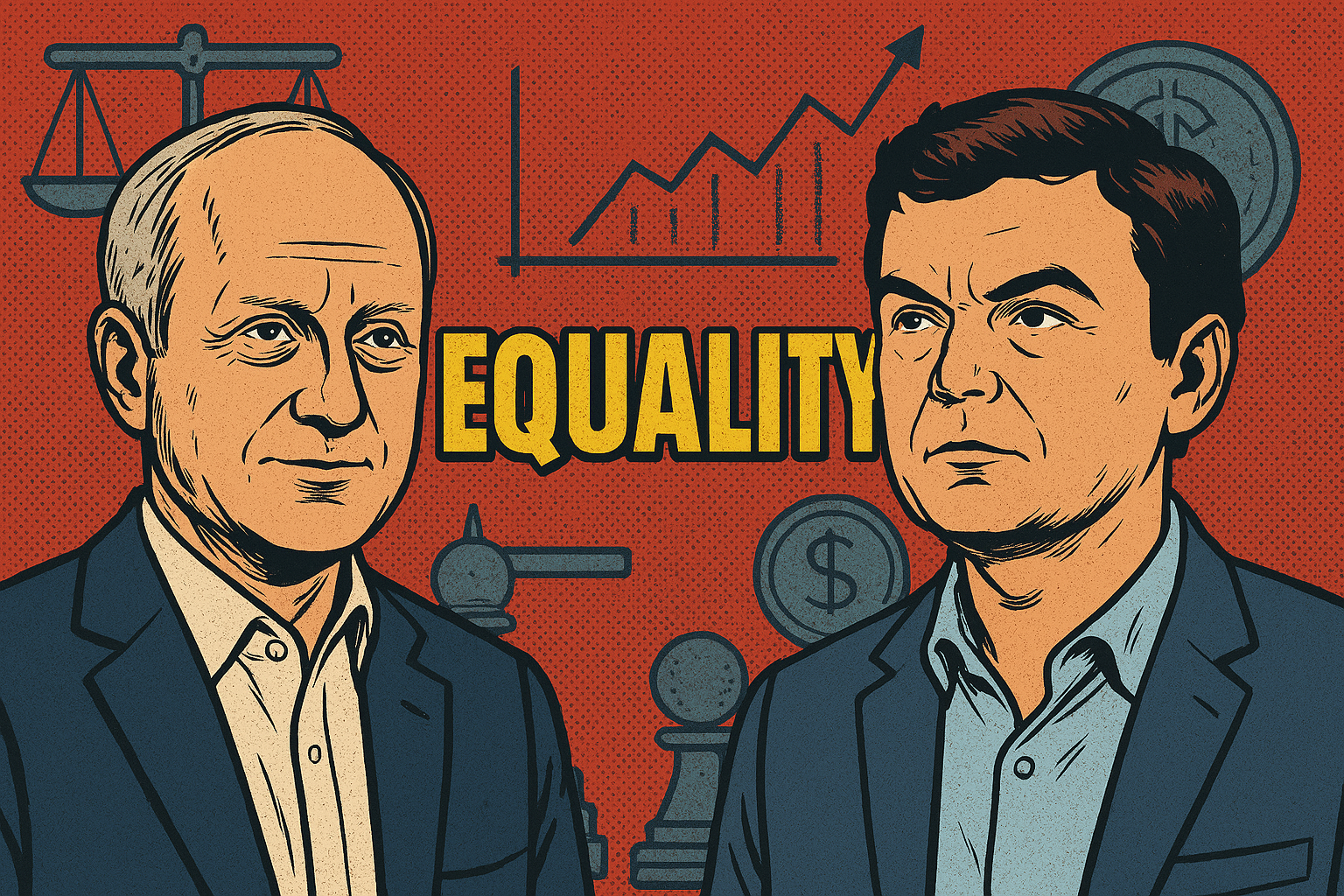
I recently finished reading “Equality: What It Means and Why It Matters,” which captures a fascinating conversation between Michael Sandel and Thomas Piketty at the Paris School of Economics (May 2024). While this book is relatively brief, it builds upon two of the most important works of recent years: Sandel’s “The Tyranny of Merit” and Piketty’s “A Brief History of Equality.”

As someone from northeastern Hungary who lived through the fall of communism in Central Europe, I find their dialogue particularly thought-provoking. Many of us who experienced the “socialist dream” firsthand entered the 1990s with unbridled optimism about free markets, believing they would solve all societal problems.
Three decades later, I can appreciate Piketty’s observation that the fall of the Soviet Union paradoxically weakened social democracy in Western nations, opening the door to what Sandel brilliantly describes as “the commodification of everything.” While I still hesitate at Piketty’s term “democratic socialism” (the word “socialism” carries heavy baggage in post-communist countries), their core argument resonates deeply.
Sandel’s exploration of “moral limits of markets” from his earlier work “What Money Can’t Buy” (which I highly recommend for its compelling arguments about discussing the boundaries of market logic) complements Piketty’s economic analysis of inequality. Together, they make a compelling case: we need robust democratic discussions about where market logic should end and other social values should begin.
Having witnessed both systems, I’m often reminded of János Kornai, Hungary’s greatest economist, whenever I find myself drawn to Piketty’s democratic socialism. Kornai wisely warned that systems prioritizing equality over freedom through central planning inevitably malfunction. Yet when Sandel and Piketty discuss the dignity of working-class people and the devastation of deindustrialization, I think of northeastern Hungary—once the heartland of socialist steel industry—where I witnessed similar suffering. The tendency to blame these “losers” of economic transition remains painfully embedded in Hungarian public discourse today.
I believe neither unfettered markets nor state-controlled economies hold all the answers. The path forward requires nuanced thinking about equality, merit, and the proper boundaries of market forces in society—while never forgetting the human cost of economic transformation.
Leave a Reply