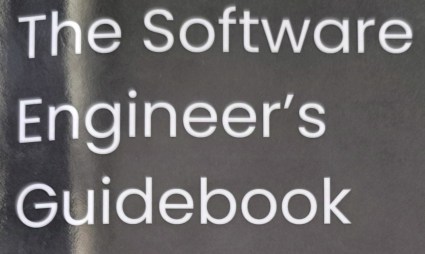
As a Hungarian software professional, I was immediately intrigued by Gergely Orosz’s “The Software Engineer’s Guidebook” – not just because we share a national background, but because of its refreshingly pragmatic approach to career development. Orosz is no ordinary career advice author. Before becoming the voice behind The Pragmatic Engineer newsletter, he spent years in the trenches as a software engineer and engineering manager, giving his advice a level of authenticity often missing from theoretical career guides.

In a tech industry flooded with generic career advice, Orosz’s book stands out. It’s not about lofty theoretical concepts, but about concrete, actionable strategies that professionals can implement immediately. From crafting resumes to managing daily work logs, the book offers practical tools that transform abstract career advice into real-world techniques.
For data scientists and technical professionals looking to be more intentional about their career growth, this book provides a roadmap that goes beyond traditional career development literature. It’s less about grand narratives and more about the day-to-day practices that compound into significant professional advancement.
In an era of generic career advice, Orosz’s approach to professional development is refreshingly practical. Unlike many career guides with vague recommendations, “The Software Engineer’s Guidebook” provides concrete, actionable strategies for advancing your career.
What sets this approach apart is the emphasis on practicality. The book doesn’t just discuss career growth in abstract terms; it offers a tangible solution by providing an actual CV template on the book’s accompanying website. This hands-on approach allows professionals to immediately start implementing effective career strategies, rather than getting lost in theoretical guidance.
The book is strategically structured to address different stages of a technical professional’s career. It’s not just a linear progression guide, but a comprehensive toolkit that speaks to various aspects of professional growth. The first section focuses on career development fundamentals, providing a solid foundation for understanding professional trajectories.
The second part delves into the nuts and bolts of being a competent developer. From time management and task prioritization to IDE optimization, testing strategies, and even leveraging AI coding tools, Orosz provides practical insights that go beyond theoretical knowledge. For data scientists, these technical skill-sharpening strategies are precious, offering ways to enhance productivity and technical proficiency.
Perhaps most compelling is the book’s third section, which explores becoming a well-rounded software developer. Here, Orosz emphasizes crucial soft skills that are often overlooked. The “under-promise, over-deliver, over-communicate” advice stands out as a key principle. This approach can be transformative for data science professionals – it’s about managing expectations, delivering high-quality work, and maintaining transparent communication.
A highlight of this section is the deep dive into often-neglected aspects of development work, such as design documents and Request for Comments (RFCs). In data science teams, where project complexity and collaboration are paramount, these tools become essential for capturing team objectives, aligning strategies, and ensuring clear communication of technical approaches.
The final sections of the book address senior-level career progression, offering insights into roles like tech lead and staff/principal engineer. Orosz’s unique recommendation is to understand both paths, even if you don’t plan to switch roles. This approach promotes empathy, understanding, and more effective collaboration across different levels of technical expertise.
This article is the first installment of a three-part series exploring essential books for data scientists seeking to expand their professional horizons. In the upcoming posts, I’ll be diving into “Leading Effective Engineering Teams” and “Product Management in Practice”. While each book offers unique insights, they collectively provide a comprehensive view of professional growth beyond traditional technical skills. By exploring these perspectives, data scientists can develop a more holistic approach to their career development.
Footnote
If you’re interested in diving deeper into the technological aspects of software engineering and understanding how to apply these principles in a data science context, another Hungarian expert can help. László Sragner’s Deliberate Machine Learning newsletter offers invaluable insights, and I recommend subscribing and exploring his older posts to complement the learnings from Orosz’s guidebook.
Leave a Reply