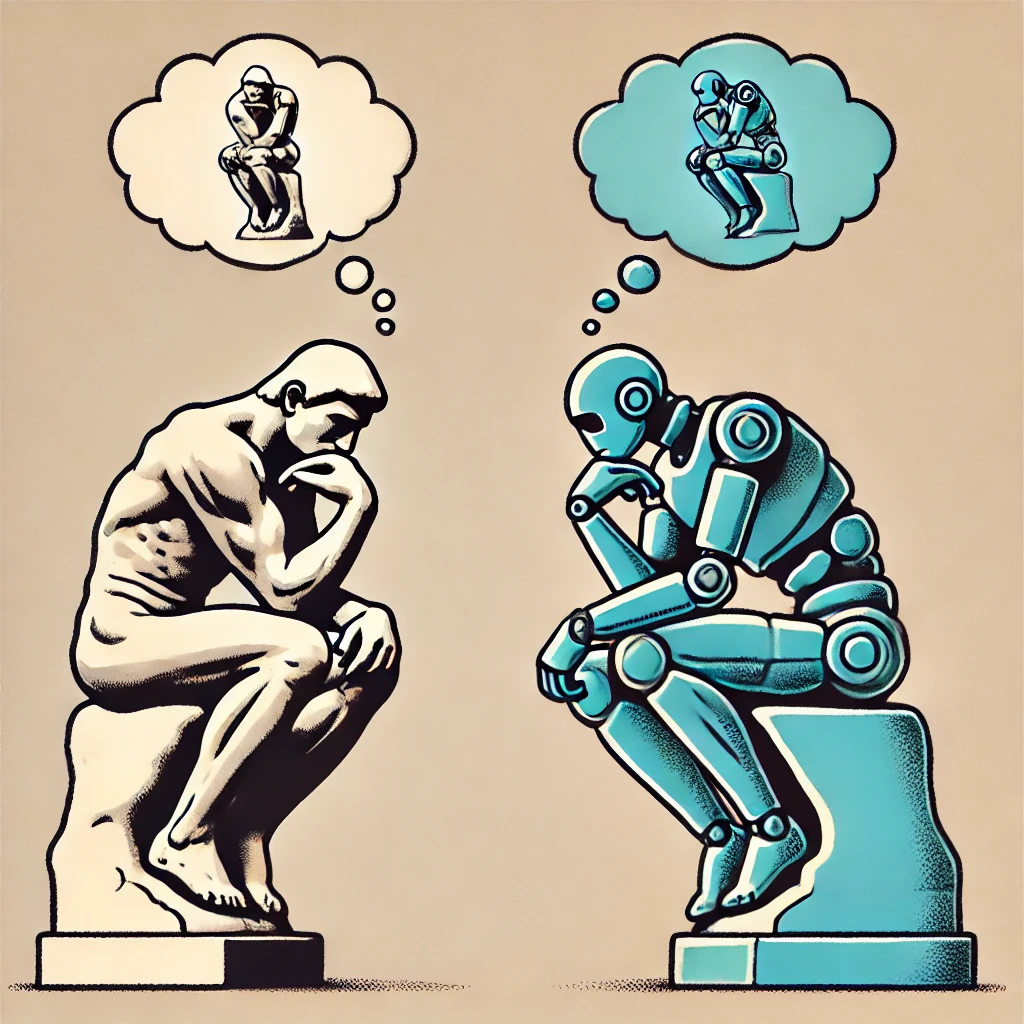
LARGE LANGUAGE MODELS (LLMs) have shown a remarkable ability to mimic human communication, making them increasingly valuable tools for everything from content creation to customer service. However, recent research reveals something unexpected about these AI systems: they consistently overestimate human rationality. When it comes to predicting human choices, they expect people to be far more logical than we are—a bias that mirrors our tendency to overestimate the rationality of others.
When asked to generate a random number between 1 and 10, humans tend to favor certain digits over others, with 7 being the most popular choice. Now, researchers have discovered that LLMs show precisely the same pattern—not because they’re programmed to, but because they’ve learned this quintessentially human bias from their training data.
Another team conducted experiments comparing how LLMs predict human choices against actual human behavior. They used classic psychology tasks developed by Daniel Kahneman and Amos Tversky, where participants choose between different gambling options with varying probabilities and rewards. The findings were striking: while human choices correlated with rational expected-value theory at just 0.48, predictions from GPT-4o (OpenAI’s latest model) correlated at 0.94.
In other words, the AI consistently expected humans to make the mathematically optimal choice, while real people showed far more variability and deviation from pure rationality.
A separate team at MIT placed LLMs directly into economic games to measure the models’ own decision-making patterns. They examined how AI systems respond in three classic experimental settings: the ultimatum game (testing fairness preferences), gambling games (measuring risk and loss aversion), and waiting games (assessing how they discount future rewards).
They found intriguing inconsistencies: in fairness situations, LLMs showed more concern about others getting less than themselves compared to humans; in risk scenarios, they demonstrated less loss aversion than humans (the tendency to feel losses more strongly than equivalent gains); and when faced with time-based decisions, they displayed stronger preferences for immediate rewards than humans did—a pattern known as hyperbolic time discounting.
The random number paradox
LLMs display remarkably human-like biases when prompted to generate random numbers in various ranges. For a 1-5 range, they predominantly select 3; for 1-10, they strongly favor 7; and for 1-100, certain numbers like 37, 42, 47, and 73 appear repeatedly.
These preferences aren’t random—they reflect documented human biases in number selection, including our tendency to avoid extremes and favor prime numbers or culturally significant digits.
Cognitive scientist Stanislas Dehaene‘s work on “number sense” helps explain this phenomenon. His research shows humans possess an intuitive relationship with numbers that emerges before formal education. We have sharper mental representations of smaller numbers than larger ones and map numbers spatially along a mental “number line.” When LLMs choose “7” as a random number, they demonstrate they’ve absorbed these same psychological patterns.
Can we change these biases?
The MIT researchers tested whether they could modify LLMs’ economic behavior through different prompting strategies. Direct instructions (“be risk-seeking”) largely failed to produce reliable changes. Zero-shot chain-of-thought prompting also showed minimal impact.
One-shot prompting (providing a single example) showed some success in altering risk preferences while role-playing prompts (“you are a senior citizen”) changed behavior but not always predictably. Interestingly, their behavior patterns shifted significantly when LLMs were asked to advise others versus make decisions themselves.
These mixed results echo findings from behavioral economics about human bias intervention. Some biases are deeply ingrained and resistant to simple interventions, while carefully reframing choices can modify others.
Why this matters
This research illuminates a crucial distinction between normative decision theory (how decisions should rationally be made) and descriptive decision theory (how decisions are made). These studies reveal that LLMs excel primarily at modeling normative decision theory while struggling with descriptive reality.
The LLMs have absorbed idealized models of decision-making rather than the messy, bias-laden processes that characterize actual human choices. This helps explain why they predict more rational behavior than humans exhibit—they’re modeling the theoretical ideal rather than the psychological reality.
Language has traditionally been viewed as a window into the human mind. As we analyze LLM-generated linguistic responses, we’re gaining a new window into “machine minds”—revealing how these systems represent human behavior and reasoning. We see reflected not only our words but also our idealized self-image as rational actors, along with the cognitive blind spots that characterize human thought.
Leave a Reply