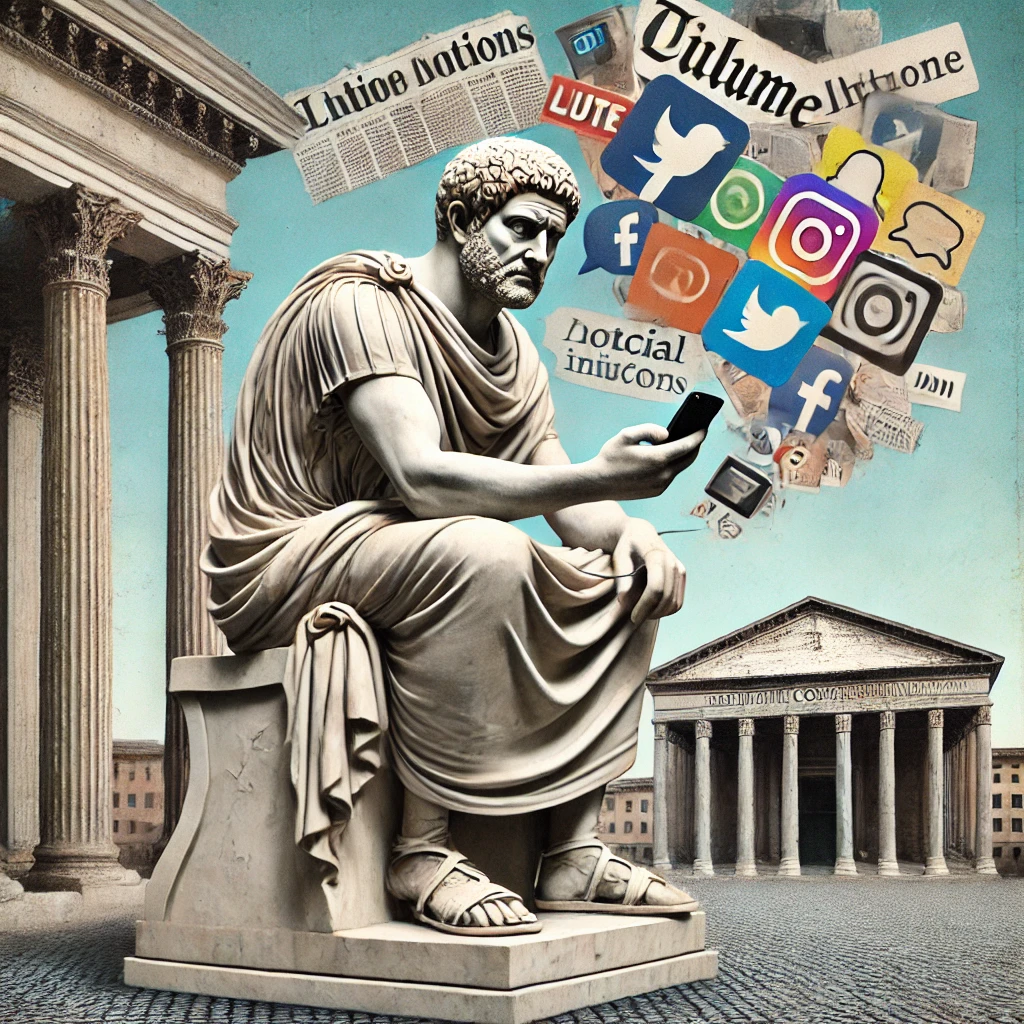
“The happiness of your life depends upon the quality of your thoughts.” This wisdom from Marcus Aurelius reminds us that attention is our most precious resource. In a world of infinite content, choosing what deserves our focus becomes an act of philosophy.
The ancient Stoics understood that true wisdom comes not from absorbing everything, but from carefully selecting what deserves our attention. As Seneca advised, “To be everywhere is to be nowhere.” In our hyperconnected world, this warning has never been more relevant.
What would Seneca think of our modern information landscape, where notifications ping incessantly and algorithms compete for every moment of our attention? I believe he would recognize it as the ultimate test of Stoic discipline—a constant exercise in choosing what truly matters.
The Stoic Path to Mindful Consumption
A mindful information diet—rooted in Stoic principles—means consuming news intentionally rather than reactively, prioritizing depth over volume, and supporting high-quality sources that contribute to genuine understanding. It’s about applying the Stoic virtue of temperance (sophrosyne) to our media habits, just as we might to other aspects of life.
My Journey: From News Junkie to Mindful Consumer
I used to be a self-proclaimed news junkie, consuming everything from political developments to technology trends. My days began and ended with news consumption. Eventually, I confronted an uncomfortable truth: despite all this “reading,” I wasn’t becoming more knowledgeable—just more distracted.
This realization came gradually. The turning point was my first child’s birth. As Seneca writes, “It is not that we have a short time to live, but that we waste a lot of it.” Suddenly, time became infinitely more precious. Did I really need hourly news checks? Was I genuinely benefiting from that constant stream of information?
With new priorities, I systematically reduced my media consumption, developing a more sustainable relationship with information that transformed how I engage with content.
The Dilemma: News Consumption vs. Information Overload
The Essential Role of News Consumption
Following the news is both a civic responsibility and a professional necessity. As citizens in a democracy, we need reliable information to vote thoughtfully and engage meaningfully in public discourse. Professionally, staying current with industry trends prevents obsolescence and reveals opportunities. The question isn’t whether to follow news, but how to do so effectively.
Paying for Quality: The Value of Journalistic Knowledge
Quality journalism isn’t free, nor should it be. As Seneca observed in his Letters to Lucilius, “Nothing is ours, except time.” When we pay for journalism, we exchange one precious resource (money) for another (curated knowledge).
Jonathan Rauch’s work on “The Constitution of Knowledge” illuminates how journalism, like science, functions as a social system of organized criticism and error correction. This makes quality journalism not merely informative but epistemologically valuable.
I view my subscriptions to quality publications as investments in better knowledge systems and ultimately in the epistemic infrastructure that democracies require. As AI-generated content proliferates, paying for human-curated, expert-vetted information becomes necessary for maintaining contact with reality.
The Costs of Information Overload
The dilemma isn’t whether to consume news, but how to do so without letting it consume us. As Marcus Aurelius advises in Meditations, “Most of what we say and do is unnecessary: remove the superfluity, and you will have more time and less bother.” This exemplifies the Stoic principle of moderation.
Constant consumption of low-quality information has real costs:
- Attention fragmentation: Our brains aren’t designed for continuous partial attention. Task-switching depletes cognitive resources—a violation of the Stoic virtue of focus.
- Superficial understanding: Skimming headlines creates an illusion of knowledge without depth. The Stoics valued true understanding over the appearance of knowledge.
- Lost opportunity: Every minute spent on low-value content could be used for genuinely restorative activities—going for a walk, enjoying nature, or simply being present.
Principles of a Mindful Information Diet
My journey toward information mindfulness taught me that staying informed isn’t about consuming more—it’s about consuming better. This approach embodies the Stoic principle of quality over quantity in all aspects of life. Here’s the framework I’ve developed:
Tactics for Smarter Consumption
1. Apply the Dichotomy of Control: Prioritize Depth Over Breaking News
In his Enchiridion, Epictetus teaches: “Some things are within our power, while others are not.” We cannot control the endless breaking news cycle, but we can control how we engage with it.
Daily news cycles trigger emotional responses, not understanding. Weekly publications like The Economist provide context and analysis that daily news lacks. Their audio edition, narrated by professional voice actors, transforms commutes and chores into learning opportunities.
By stepping back from constant breaking news, I’ve gained perspective without losing awareness of important events.
2. Practice Practical Wisdom (Phronesis): Select Quality Sources for Specialized Knowledge
The Stoic virtue of practical wisdom involves making sound judgments about what truly matters. For information consumption, this means carefully selecting sources that provide genuine value.
For areas where I want genuine understanding, I focus on publications known for depth and accuracy. For science and technology, Quanta Magazine and MIT Technology Review provide thoughtful coverage that goes beyond sensationalism.
These publications employ expert journalists who take the time to explain complex topics accurately rather than rushing to publish clickbait.
3. Exercise Self-Discipline: Use RSS for Controlled Curation
Self-discipline was central to Stoic practice. Controlling what enters our information stream requires similar discipline in our digital world.
Despite its “old school” reputation, RSS remains one of the most potent tools for mindful consumption. Unlike algorithm-driven platforms, RSS gives me complete control over what enters my information stream.
I’ve used Feedly and now Inoreader to follow about 25 carefully selected sources. This approach works because I don’t feel compelled to check the app daily. When I do open it, I’m selective about which articles deserve my attention, usually choosing just a few posts when time permits.
This approach allows me to check in on my schedule rather than being constantly interrupted by notifications, while still maintaining awareness of developments in areas that matter to me.
4. Practice Regular Self-Examination: Audit Your Information Sources
The Stoics emphasized regular self-examination. Seneca would review his day each evening, considering what he did well and where he could improve. We can apply this practice to our information diet.
Information sources can deteriorate over time or no longer serve your evolving interests. Twice yearly, I review every subscription, newsletter, and RSS feed, asking:
- Has this source consistently provided value over the past six months?
- Does this align with my current priorities and interests?
- Is there redundancy across my sources?
This regular pruning prevents information creep and keeps my content diet intentional.
5. Apply Temperance (Sophrosyne): Be Selective with Newsletters
Temperance—knowing when enough is enough—is essential for managing information in a world of abundance.
I’ve admired newsletter editors’ ability to curate and synthesize information. There are countless high-quality newsletters available today. However, I found myself subscribing to many but reading few.
After a ruthless pruning, I follow just four that consistently provide value: The Batch, The Pragmatic Engineer, Deliberate Machine Learning, and Marcus on AI. Each offers unique insights I can’t easily find elsewhere and has proven its worth over time.
6. Honor the Value of Your Time: Apply Quality Filters to Video and Audio Content
The Stoics viewed time as our most precious non-renewable resource. Honoring its value means being highly selective about how we spend it.
With the explosion of podcasts and YouTube channels, one could spend weeks consuming content without reaching the end. The abundance demands extreme selectivity.
I’ve narrowed my video and audio consumption to just a handful of sources: Two Minute Papers, Sabine Hossenfelder, and Machine Learning Street Talk for scientific and technical content, plus one Hungarian channel for politics and current affairs.
Even with this limited selection, I don’t feel obligated to watch or listen to everything they produce. I consume only what seems most relevant and interesting to my current priorities and interests.
The Benefits of a Curated Approach
Since implementing these changes, I’ve experienced significant benefits that reflect the Stoic ideal of eudaimonia—a state of flourishing that comes from living virtuously:
- Reduced anxiety: Breaking the cycle of constant news checking has lowered my background stress levels.
- More time for books: Both fiction and non-fiction reading have increased, providing even greater depth and perspective.
- Better retention: I remember what I read because I’m not constantly jumping between disparate topics.
- More time outdoors: Limiting low-value content consumption has freed up time for walks and other restorative activities.
Finding Your Balance: The Stoic Approach
The Stoics emphasized distinguishing between what we can and cannot control. We cannot control the flow of world events or the constant content production. But we can control our response to it, specifically, how we allocate our precious attention.
As Epictetus taught, “Make the best use of what is in your power, and take the rest as it happens.” In modern terms: curate your information intake deliberately, and accept that you’ll miss some things.
This doesn’t mean withdrawing from current events. Rather, it means engaging with them intentionally. Democracy requires informed citizens, and career success requires industry awareness. But neither demands constant consumption of every headline.
In his Meditations (Book 7.2), Marcus Aurelius reminds us: “Do what nature now requires. Set yourself in motion, if it is in your power, and do not look about to see if anyone will observe it; nor expect Plato’s Republic, but be content if the smallest thing goes well, and consider such an outcome no small matter.”
The right balance looks different for everyone. The key is making conscious choices rather than defaulting to patterns designed to maximize engagement.
Ask yourself: What information helps me fulfill my duties as a citizen and professional? What knowledge contributes to virtue and wisdom rather than anxiety and distraction?
Then design your information diet accordingly. Remember Seneca’s warning that “life is long enough, and a sufficiently generous amount has been given to us for the highest achievements if it were all well invested.”
Take five minutes to reflect tonight: Which information sources contributed to your wisdom today? Which could you eliminate without meaningful loss? Your attention is precious—ensure it’s invested in content worthy of your time.
Leave a Reply